How to Tell if a Website Is Built on Shopify
The fingerprints every Shopify store leaves behind, from cdn/shop image paths to the checkout, and how to read them in a minute.
Article Summary: A website runs on Shopify if its page source contains a Shopify.theme record, images served from /cdn/shop/ or cdn.shopify.com, or a myshopify.com address. A theme detector checks all of these at once and also catches headless Shopify stores through their response headers.
- Shopify storefronts serve images and files from paths containing /cdn/shop/ or from cdn.shopify.com.
- Every Shopify store has a permanent store.myshopify.com address, which often appears in its page source.
- Shopify sends response headers such as x-shopid and powered-by, visible even on some headless stores.
- Headless Shopify stores built with Hydrogen may show no theme but still use Shopify checkout.
Shopify powers a huge share of online stores, but most of them use their own domain and a polished theme, so there is no Shopify logo in sight. A few minutes with the page source, or one check with a detector, settles it.
Check one: look at the image addresses
Right click any product image and choose "Open image in new tab", then look at the address bar. Shopify stores serve their files from one of two places:
- Their own domain followed by
/cdn/shop/files/or/cdn/shop/products/ - The shared Shopify CDN at
cdn.shopify.com/s/files/
Either pattern is a near certain sign of Shopify. No other major platform uses the /cdn/shop/ path.
Check two: search the page source
View the page source with Ctrl+U on Windows or Option+Command+U on a Mac, then search for these strings:
| Search for | What it tells you |
|---|---|
Shopify.theme | The store's theme record, with the theme name and version |
myshopify.com | The store's permanent Shopify address |
ShopifyAnalytics | Shopify's built in analytics, present on every standard storefront |
shopify-digital-wallet | Shopify's checkout buttons such as Shop Pay |
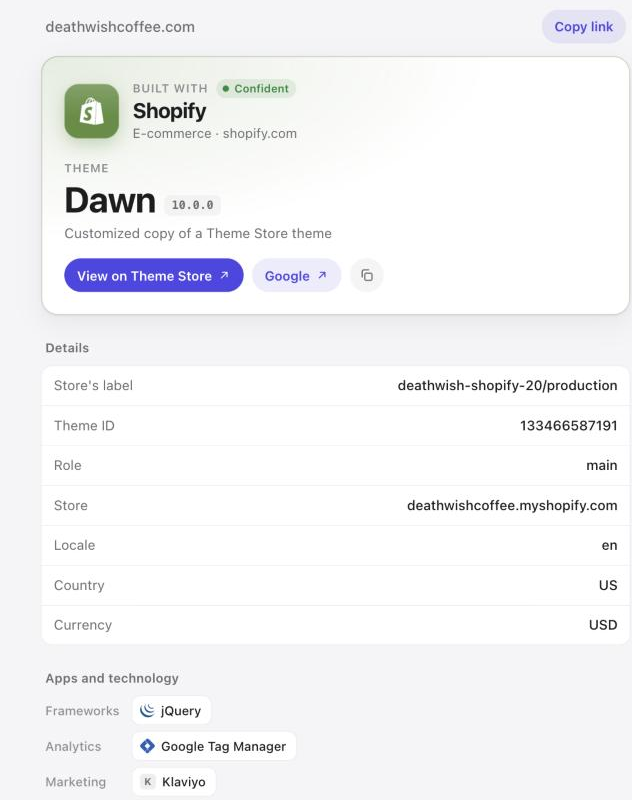
Finding even one of them is strong evidence. Finding two or more is conclusive, and our detector marks that as a confident result.
Check three: visit the checkout
Add any product to the cart and go to checkout. Standard Shopify stores show Shopify's own checkout, often with Shop Pay at the top. Some stores move checkout to a subdomain, but the layout is recognizable once you have seen it a few times.
Check four: read the response headers
This one needs the browser's developer tools. Open them with F12, go to the Network tab, reload and click the first request. Shopify adds headers such as x-shopid, x-shopify-stage and powered-by: Shopify. Headers are useful because a store can change its theme and markup, but it rarely controls these.
Check five: watch for headless stores
A growing number of large brands use Shopify behind the scenes but build their storefront with a separate framework, an approach called headless commerce. Shopify's own framework for this is Hydrogen. A headless store may have no Shopify.theme record at all, but it often still shows Shopify headers, Shopify image paths or Shopify checkout.
When a detector finds Shopify but no theme, a headless build is the usual reason. There is no theme to buy in that case, because the design is custom software.
Why it matters
Knowing a competitor runs on Shopify tells you a lot. You can find what Shopify theme a store uses, which apps it relies on and how it handles checkout, all of which you can match on your own store.
Start your own Shopify storeStart with a free trial. Partner link.Frequently asked questions
How can I tell if a store is Shopify without any tools?
Open a product image in a new tab and check its address for /cdn/shop/ or cdn.shopify.com. Then search the page source for "Shopify.theme". Either one is a reliable sign.
Do all Shopify stores show "myshopify.com"?
Every Shopify store has a myshopify.com address, but not every page mentions it. It often appears in scripts or the checkout, so search the page source for it.
Can a Shopify store hide that it uses Shopify?
It can remove some signs, but not all. Image paths, checkout and response headers are hard to hide, which is why a detector that checks many signals at once is more reliable than any single check.
Is a headless store still a Shopify store?
Yes. It uses Shopify for products, inventory and checkout, and a separate front end for its pages. It just doesn't use a Shopify theme.
Keep reading
 ShopifyHow to Find Out What Shopify Theme a Store Is UsingThree reliable ways to identify any Shopify theme, including renamed and customized themes that fool most detectors.
 ShopifyHow to Find Which Apps a Shopify Store Is UsingHow to read the apps a Shopify store loads, and which ones top brands use most, from Klaviyo to Yotpo and Rebuy.
 GuidesWhat CMS Is This Website Using? How to Check Any SiteThe fingerprints of every major CMS and site builder, in one table, plus how a CMS detector reads them for you.